Image 1 of 3
Image 2 of 3
Image 3 of 3
Perimenopause Mental Health Screener | Therapist Clinical Intake Tool | LPCC-Created PDF | Instant Download
$18.00
Your perimenopausal clients are in the room. Do you have the right tool to open the conversation?
Many of the women showing up in your practice right now — anxious, exhausted, emotionally dysregulated, not recognizing themselves — are in the middle of the perimenopause transition. But without a structured screener, that connection often gets missed. The hormonal, cognitive, and identity-level changes they're experiencing get labeled as depression, anxiety, or personality — when the real story is far more complex.
Perimenopause & Mental Health: A Clinical Intake & Reference Tool was developed by Christina Castro, LPCC, a California-licensed therapist specializing in attachment trauma, EMDR, and mental health during menopause. This is a peer-designed, clinician-to-clinician resource — built for use in actual practice, not as a theoretical exercise.
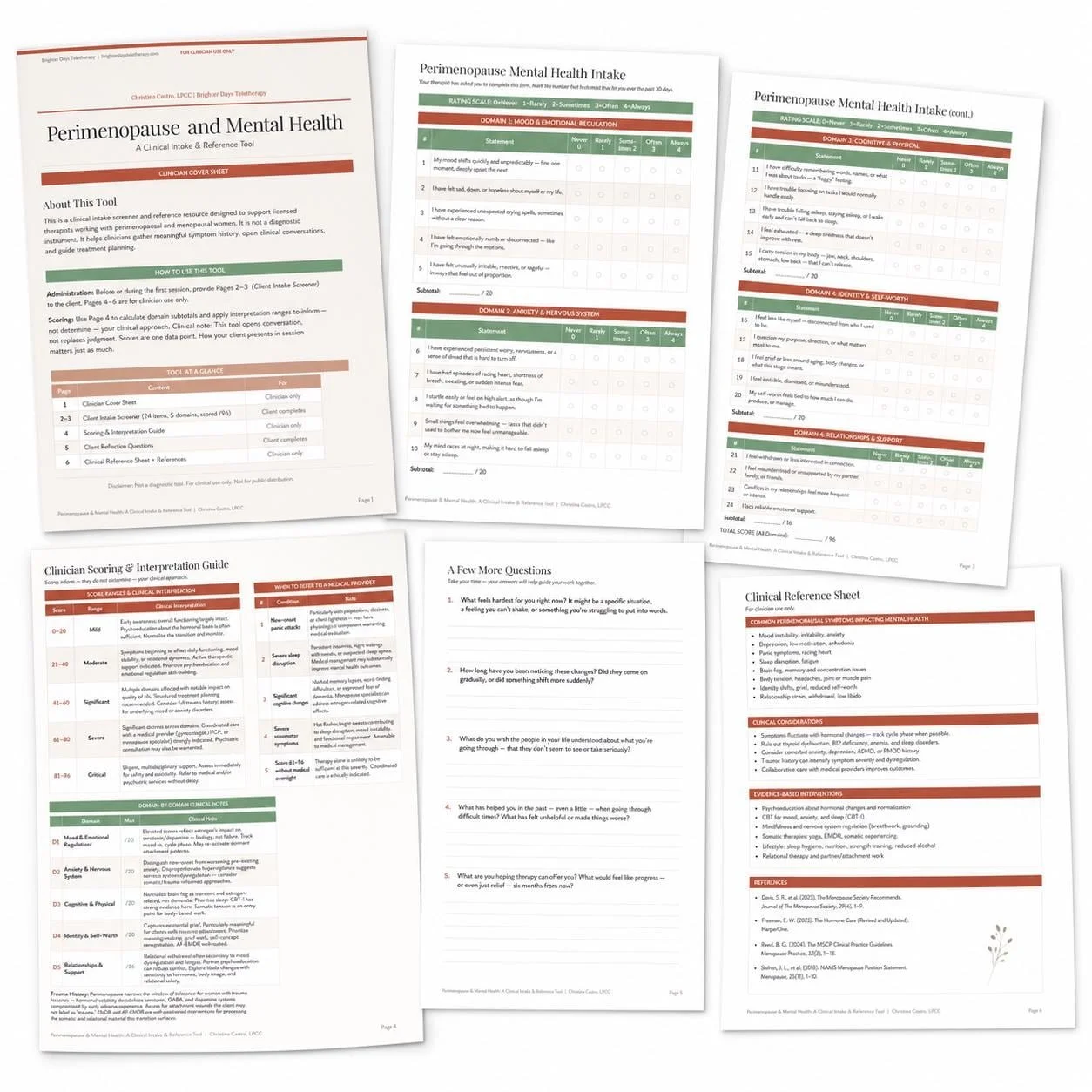
What's Inside — 6 Pages
Page 1 — Clinician Cover Sheet (For your eyes only)
Overview of the tool, administration instructions, and a quick at-a-glance guide showing which pages go to the client and which stay with you.
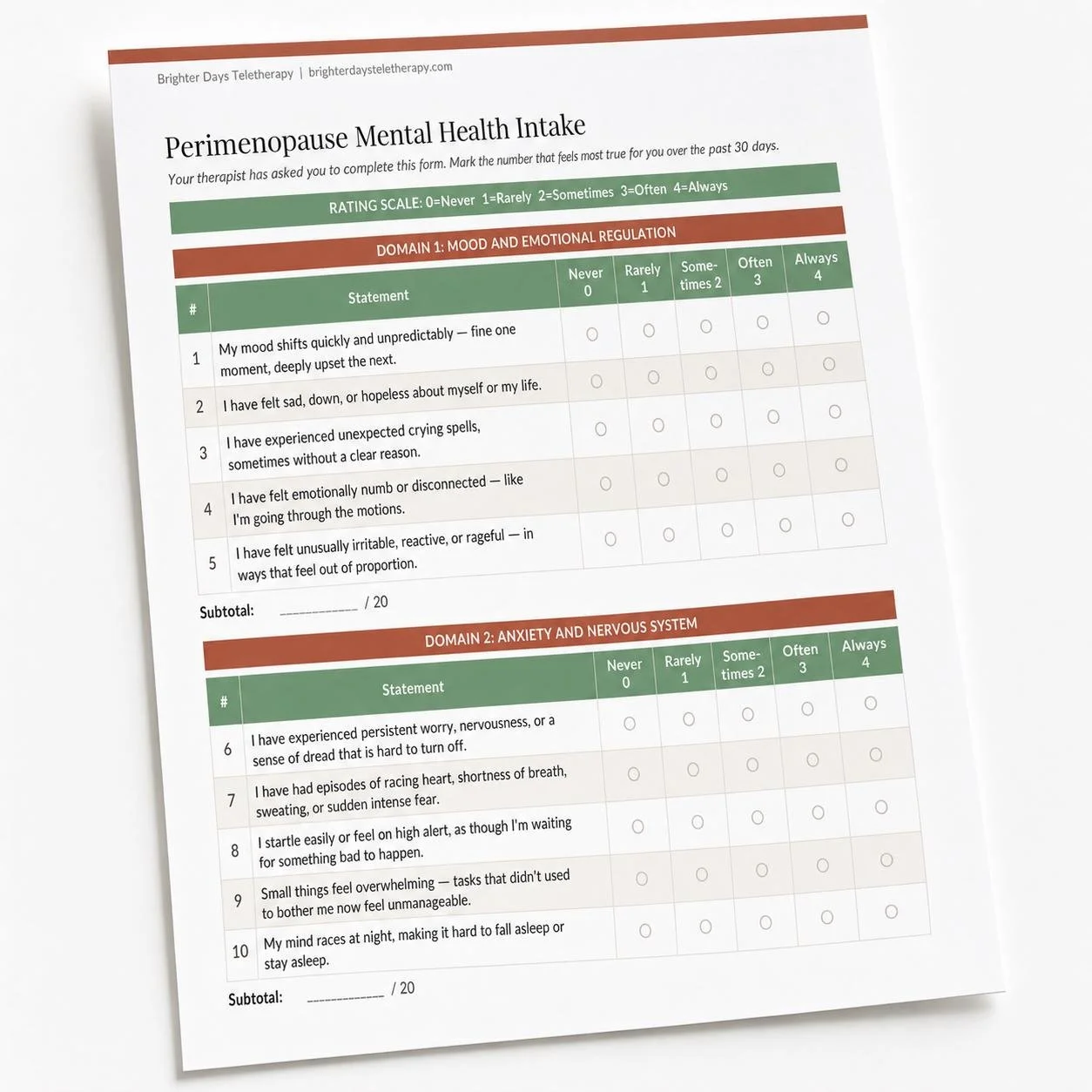
Pages 2–3 — Client Intake Screener (Client-facing)
24 structured items across 5 symptom domains. Clients rate each item on a 0–4 scale. Domains include:
Mood & Emotional Regulation
Anxiety & Nervous System
Cognitive & Physical (including brain fog and sleep)
Identity & Self-Worth
Relationships & Support
Scoring summary table on page 3. Designed to be completed independently before or during a first session.
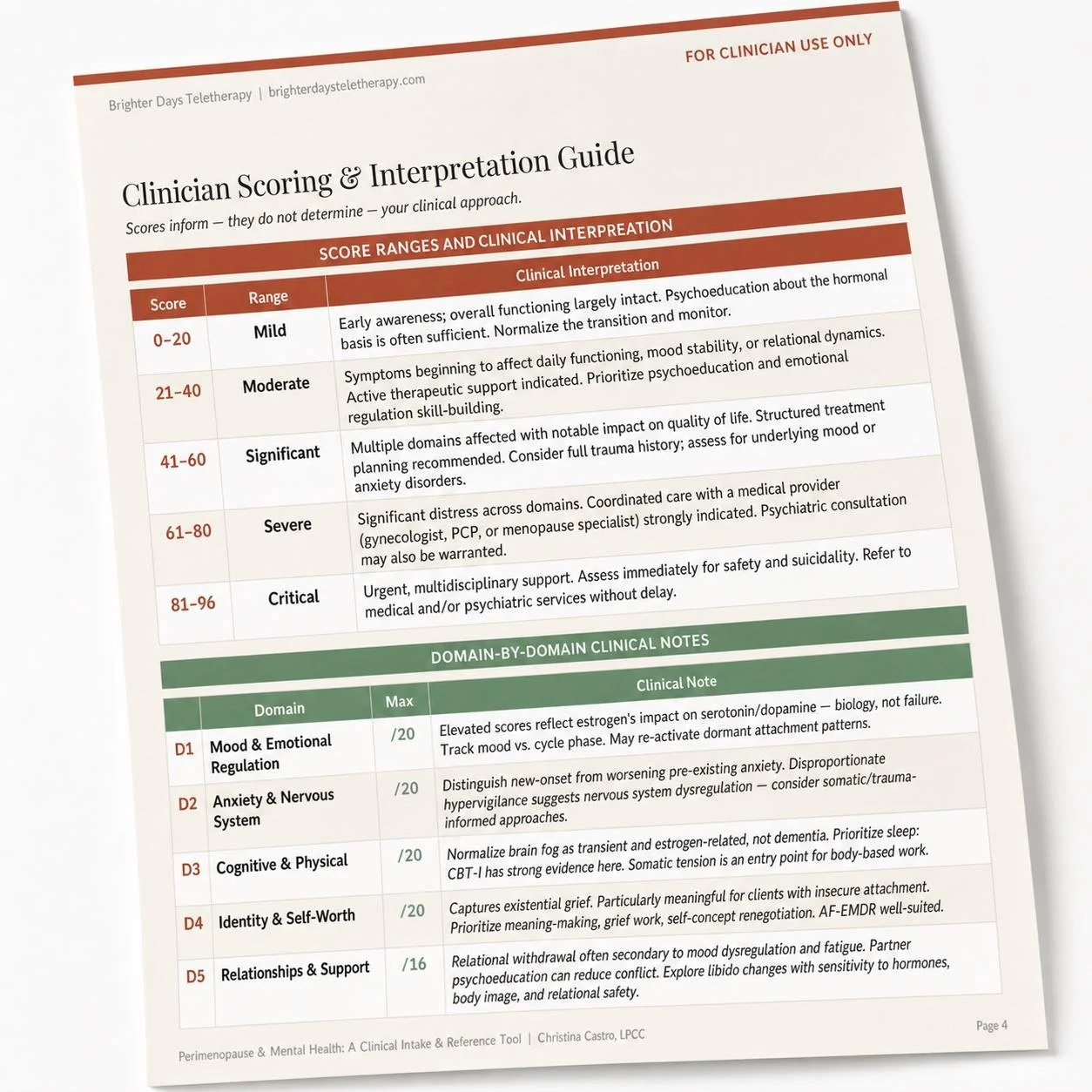
Page 4 — Scoring & Interpretation Guide (Clinician only)
Five score range bands (Mild through Critical) with clinical interpretation for each. Domain-by-domain notes on what elevated scores actually mean neurobiologically — including reframes for affect dysregulation as hormonal, not characterological. Includes a When to Refer to a Medical Provider reference table.
Page 5 — Client Reflection Questions (Client-facing)
Five warm, open-ended questions with handwriting lines — designed to surface the emotional and relational context your client may not volunteer without prompting.
Page 6 — Clinician Reference Sheet (Clinician only)
A one-page clinical desk reference covering:
Key prevalence statistics (mood disorders, anxiety, brain fog, sleep disruption, PTSD)
The estrogen-brain connection explained for clinical use
Evidence-based intervention guidance: EMDR/AF-EMDR, CBT-I, somatic approaches, psychoeducation, coordinated medical care
13 peer-reviewed and institutional references
Who This Is For
This tool is designed for licensed therapists, counselors, psychologists, and social workers who work with women in perimenopause or menopause — or who suspect they do, and want a structured way to surface and assess what's really going on.
It is particularly relevant for clinicians using:
EMDR or Attachment-Focused EMDR (AF-EMDR)
Trauma-informed and somatic approaches
CBT or CBT-I
Integrative or collaborative-care models
This tool is not for general consumers. It is a clinical resource designed for professional use only.
How to Use It
Print and administer: Provide pages 2–3 to the client before or during the intake session. Pages 1, 4, and 6 stay with you as the clinician.
Digital use: Open in Adobe Acrobat, GoodNotes, Notability, or any PDF-compatible app. Clients can complete pages 2–3 on an iPad or tablet using a stylus if preferred.
What You Receive
Immediately after purchase, Etsy delivers a 6-page PDF directly to your account. No waiting, no shipping. Go to your Etsy account → Purchases & Reviews → click Download.
You receive a single-use professional license for use within your own practice. The file is not for resale or redistribution.
Questions? Message me — I'm happy to help.
This tool is not a diagnostic instrument. For licensed clinical use only. Not for distribution to the general public. The scoring system is designed to inform clinical judgment, not replace it.

Many of the women showing up in your practice right now — anxious, exhausted, emotionally dysregulated, not recognizing themselves — are in the middle of the perimenopause transition. But without a structured screener, that connection often gets missed. The hormonal, cognitive, and identity-level changes they're experiencing get labeled as depression, anxiety, or personality — when the real story is far more complex.
Perimenopause & Mental Health: A Clinical Intake & Reference Tool was developed by Christina Castro, LPCC, a California-licensed therapist specializing in attachment trauma, EMDR, and mental health during menopause. This is a peer-designed, clinician-to-clinician resource — built for use in actual practice, not as a theoretical exercise.
What's Inside — 6 Pages
Page 1 — Clinician Cover Sheet (For your eyes only)
Overview of the tool, administration instructions, and a quick at-a-glance guide showing which pages go to the client and which stay with you.
Pages 2–3 — Client Intake Screener (Client-facing)
24 structured items across 5 symptom domains. Clients rate each item on a 0–4 scale. Domains include:
Mood & Emotional Regulation
Anxiety & Nervous System
Cognitive & Physical (including brain fog and sleep)
Identity & Self-Worth
Relationships & Support
Scoring summary table on page 3. Designed to be completed independently before or during a first session.
Page 4 — Scoring & Interpretation Guide (Clinician only)
Five score range bands (Mild through Critical) with clinical interpretation for each. Domain-by-domain notes on what elevated scores actually mean neurobiologically — including reframes for affect dysregulation as hormonal, not characterological. Includes a When to Refer to a Medical Provider reference table.
Page 5 — Client Reflection Questions (Client-facing)
Five warm, open-ended questions with handwriting lines — designed to surface the emotional and relational context your client may not volunteer without prompting.
Page 6 — Clinician Reference Sheet (Clinician only)
A one-page clinical desk reference covering:
Key prevalence statistics (mood disorders, anxiety, brain fog, sleep disruption, PTSD)
The estrogen-brain connection explained for clinical use
Evidence-based intervention guidance: EMDR/AF-EMDR, CBT-I, somatic approaches, psychoeducation, coordinated medical care
13 peer-reviewed and institutional references
Who This Is For
This tool is designed for licensed therapists, counselors, psychologists, and social workers who work with women in perimenopause or menopause — or who suspect they do, and want a structured way to surface and assess what's really going on.
It is particularly relevant for clinicians using:
EMDR or Attachment-Focused EMDR (AF-EMDR)
Trauma-informed and somatic approaches
CBT or CBT-I
Integrative or collaborative-care models
This tool is not for general consumers. It is a clinical resource designed for professional use only.
How to Use It
Print and administer: Provide pages 2–3 to the client before or during the intake session. Pages 1, 4, and 6 stay with you as the clinician.
Digital use: Open in Adobe Acrobat, GoodNotes, Notability, or any PDF-compatible app. Clients can complete pages 2–3 on an iPad or tablet using a stylus if preferred.
What You Receive
Immediately after purchase, Etsy delivers a 6-page PDF directly to your account. No waiting, no shipping. Go to your Etsy account → Purchases & Reviews → click Download.
You receive a single-use professional license for use within your own practice. The file is not for resale or redistribution.
Questions? Message me — I'm happy to help.
This tool is not a diagnostic instrument. For licensed clinical use only. Not for distribution to the general public. The scoring system is designed to inform clinical judgment, not replace it.
Your perimenopausal clients are in the room. Do you have the right tool to open the conversation?
Many of the women showing up in your practice right now — anxious, exhausted, emotionally dysregulated, not recognizing themselves — are in the middle of the perimenopause transition. But without a structured screener, that connection often gets missed. The hormonal, cognitive, and identity-level changes they're experiencing get labeled as depression, anxiety, or personality — when the real story is far more complex.
Perimenopause & Mental Health: A Clinical Intake & Reference Tool was developed by Christina Castro, LPCC, a California-licensed therapist specializing in attachment trauma, EMDR, and mental health during menopause. This is a peer-designed, clinician-to-clinician resource — built for use in actual practice, not as a theoretical exercise.
What's Inside — 6 Pages
Page 1 — Clinician Cover Sheet (For your eyes only)
Overview of the tool, administration instructions, and a quick at-a-glance guide showing which pages go to the client and which stay with you.
Pages 2–3 — Client Intake Screener (Client-facing)
24 structured items across 5 symptom domains. Clients rate each item on a 0–4 scale. Domains include:
Mood & Emotional Regulation
Anxiety & Nervous System
Cognitive & Physical (including brain fog and sleep)
Identity & Self-Worth
Relationships & Support
Scoring summary table on page 3. Designed to be completed independently before or during a first session.
Page 4 — Scoring & Interpretation Guide (Clinician only)
Five score range bands (Mild through Critical) with clinical interpretation for each. Domain-by-domain notes on what elevated scores actually mean neurobiologically — including reframes for affect dysregulation as hormonal, not characterological. Includes a When to Refer to a Medical Provider reference table.
Page 5 — Client Reflection Questions (Client-facing)
Five warm, open-ended questions with handwriting lines — designed to surface the emotional and relational context your client may not volunteer without prompting.
Page 6 — Clinician Reference Sheet (Clinician only)
A one-page clinical desk reference covering:
Key prevalence statistics (mood disorders, anxiety, brain fog, sleep disruption, PTSD)
The estrogen-brain connection explained for clinical use
Evidence-based intervention guidance: EMDR/AF-EMDR, CBT-I, somatic approaches, psychoeducation, coordinated medical care
13 peer-reviewed and institutional references
Who This Is For
This tool is designed for licensed therapists, counselors, psychologists, and social workers who work with women in perimenopause or menopause — or who suspect they do, and want a structured way to surface and assess what's really going on.
It is particularly relevant for clinicians using:
EMDR or Attachment-Focused EMDR (AF-EMDR)
Trauma-informed and somatic approaches
CBT or CBT-I
Integrative or collaborative-care models
This tool is not for general consumers. It is a clinical resource designed for professional use only.
How to Use It
Print and administer: Provide pages 2–3 to the client before or during the intake session. Pages 1, 4, and 6 stay with you as the clinician.
Digital use: Open in Adobe Acrobat, GoodNotes, Notability, or any PDF-compatible app. Clients can complete pages 2–3 on an iPad or tablet using a stylus if preferred.
What You Receive
Immediately after purchase, Etsy delivers a 6-page PDF directly to your account. No waiting, no shipping. Go to your Etsy account → Purchases & Reviews → click Download.
You receive a single-use professional license for use within your own practice. The file is not for resale or redistribution.
Questions? Message me — I'm happy to help.
This tool is not a diagnostic instrument. For licensed clinical use only. Not for distribution to the general public. The scoring system is designed to inform clinical judgment, not replace it.
Many of the women showing up in your practice right now — anxious, exhausted, emotionally dysregulated, not recognizing themselves — are in the middle of the perimenopause transition. But without a structured screener, that connection often gets missed. The hormonal, cognitive, and identity-level changes they're experiencing get labeled as depression, anxiety, or personality — when the real story is far more complex.
Perimenopause & Mental Health: A Clinical Intake & Reference Tool was developed by Christina Castro, LPCC, a California-licensed therapist specializing in attachment trauma, EMDR, and mental health during menopause. This is a peer-designed, clinician-to-clinician resource — built for use in actual practice, not as a theoretical exercise.
What's Inside — 6 Pages
Page 1 — Clinician Cover Sheet (For your eyes only)
Overview of the tool, administration instructions, and a quick at-a-glance guide showing which pages go to the client and which stay with you.
Pages 2–3 — Client Intake Screener (Client-facing)
24 structured items across 5 symptom domains. Clients rate each item on a 0–4 scale. Domains include:
Mood & Emotional Regulation
Anxiety & Nervous System
Cognitive & Physical (including brain fog and sleep)
Identity & Self-Worth
Relationships & Support
Scoring summary table on page 3. Designed to be completed independently before or during a first session.
Page 4 — Scoring & Interpretation Guide (Clinician only)
Five score range bands (Mild through Critical) with clinical interpretation for each. Domain-by-domain notes on what elevated scores actually mean neurobiologically — including reframes for affect dysregulation as hormonal, not characterological. Includes a When to Refer to a Medical Provider reference table.
Page 5 — Client Reflection Questions (Client-facing)
Five warm, open-ended questions with handwriting lines — designed to surface the emotional and relational context your client may not volunteer without prompting.
Page 6 — Clinician Reference Sheet (Clinician only)
A one-page clinical desk reference covering:
Key prevalence statistics (mood disorders, anxiety, brain fog, sleep disruption, PTSD)
The estrogen-brain connection explained for clinical use
Evidence-based intervention guidance: EMDR/AF-EMDR, CBT-I, somatic approaches, psychoeducation, coordinated medical care
13 peer-reviewed and institutional references
Who This Is For
This tool is designed for licensed therapists, counselors, psychologists, and social workers who work with women in perimenopause or menopause — or who suspect they do, and want a structured way to surface and assess what's really going on.
It is particularly relevant for clinicians using:
EMDR or Attachment-Focused EMDR (AF-EMDR)
Trauma-informed and somatic approaches
CBT or CBT-I
Integrative or collaborative-care models
This tool is not for general consumers. It is a clinical resource designed for professional use only.
How to Use It
Print and administer: Provide pages 2–3 to the client before or during the intake session. Pages 1, 4, and 6 stay with you as the clinician.
Digital use: Open in Adobe Acrobat, GoodNotes, Notability, or any PDF-compatible app. Clients can complete pages 2–3 on an iPad or tablet using a stylus if preferred.
What You Receive
Immediately after purchase, Etsy delivers a 6-page PDF directly to your account. No waiting, no shipping. Go to your Etsy account → Purchases & Reviews → click Download.
You receive a single-use professional license for use within your own practice. The file is not for resale or redistribution.
Questions? Message me — I'm happy to help.
This tool is not a diagnostic instrument. For licensed clinical use only. Not for distribution to the general public. The scoring system is designed to inform clinical judgment, not replace it.