Therapy for women: perimenopause, hormones and mood.
Anxious, irritable, waking up with a sense of dread, or just not feeling like yourself? When your hormones shift, your mood, your sleep and even your health can shift with them. You're not losing your mind, and you don't have to white-knuckle your way through this.

Who I work with
Women whose mental health is tangled up with their hormones and their health.
Perimenopause and midlife
Anxiety, rage, dread and low mood that show up in your 40s and 50s.
Learn more ↓PMDD and hormone-sensitive mood
Mood that crashes in the week or two before your period, every month.
Learn more ↓Bipolar disorder through hormonal changes
Staying steady through your cycle, postpartum and perimenopause, alongside your psychiatrist.
Learn more ↓Chronic illness and autoimmune conditions
Living with a body that flares, and the stress, grief and trauma that can come with it.
Learn more ↓Why this happens, and why it's not your fault
During perimenopause, estrogen and progesterone rise and fall unpredictably for several years before periods stop. Those hormones affect mood, sleep and how the brain handles stress. At the same time, midlife often brings a heavy load: teenagers, aging parents, work pressure, relationship changes, and questions about who you are now.
That combination can bring up anxiety, irritability, low mood, and the sense of doom or dread many women describe. It can also stir up old patterns or past experiences that you thought were behind you. In a study of more than 128,000 women, the risk of a first episode of depression rose about 30% during perimenopause.
- ●Waking at 3 a.m. with your mind racing, or a heavy sense of dread you can't explain
- ●Anxiety that showed up out of nowhere in your 40s
- ●Snapping at the people you love, then feeling guilty about it
- ●Crying more easily, or feeling flat and numb
- ●Brain fog that makes you doubt yourself at work
- ●Losing confidence you used to take for granted
- ●Feeling stretched between kids, aging parents, a career and a partner
- ●Wondering, “Is this me, or is it my hormones?”
PMDD and mood that follows your cycle
Premenstrual dysphoric disorder (PMDD) is much more than “bad PMS.” In the week or two before your period, you might feel hopeless, furious, anxious or not like yourself at all. Then it lifts a few days after your period starts, and you're left cleaning up the damage to your relationships, your work and your confidence. PMDD affects an estimated 3 to 8% of women of reproductive age, and many go years without a name for it.
Some women are especially sensitive to hormone changes, and that sensitivity often shows up more than once: before periods, after having a baby, and again in perimenopause. If PMDD or postpartum depression is part of your story, it's worth paying attention as you approach midlife.
- ●Track your mood alongside your cycle, so you can see the pattern and plan for it
- ●Build a plan for the hard days before they arrive
- ●Work on the shame and the relationship fallout that PMDD can leave behind
- ●Coordinate with your doctor if you're exploring medical treatment
Bipolar disorder and hormonal changes
If you live with bipolar disorder, you may have noticed that your mood is harder to manage at certain times: before your period, after having a baby, or now, in perimenopause. You're not imagining it. A large 2024 study of more than 128,000 women found that first episodes of mania, the defining feature of bipolar disorder, were about twice as common during perimenopause as in the years before it. And among women who already have bipolar disorder, those with a history of PMS, PMDD or postpartum depression were more likely to have a mood episode during perimenopause.
Therapy doesn't replace medication for bipolar disorder, but it can help you:
- ●Notice early warning signs and act on them sooner
- ●Protect sleep and routines, which matter even more when hormones are shifting
- ●Track mood alongside your cycle or perimenopause symptoms, and share that with your prescriber
- ●Work through the grief, stress and history that come with living with a serious mood condition
When your health and your mood are tangled together
About 80% of people with autoimmune diseases are women. If you live with lupus, rheumatoid arthritis, Hashimoto's, MS, Sjögren's or another chronic condition, you know it doesn't stay in your body. It affects your mood, your energy, your work, your relationships, and how much you can count on yourself from one week to the next.
Hormones play a part too. Many autoimmune conditions change during pregnancy and around menopause, and some women notice flares that track with their cycle or with perimenopause.
How therapy helps
- Coping with flares, fatigue, pain and the unpredictability of chronic illness
- Grieving the life you planned and building one that fits the body you have
- Working through past trauma with EMDR, at a pace your body can handle
- Speaking up for yourself with doctors who don't always listen
- Noticing how stress, sleep and your cycle or perimenopause affect your symptoms, and sharing that with your care team
I understand this personally
I bring both professional training and lived experience to this work. I know what it's like when your hormones and your health are tangled together, and why your care team needs to work together.
- ●In a Swedish study of more than 100,000 people with stress-related disorders such as PTSD, the risk of later developing an autoimmune disease was 36% higher. For PTSD, it was 46% higher. (Song et al., JAMA, 2018)
- ●In a study that followed nearly 55,000 US women for 24 years, women with PTSD symptoms had nearly 3 times the risk of developing lupus. (Roberts et al., Arthritis & Rheumatology, 2017)
- ●In two large studies of more than 100,000 women, each additional difficult childhood experience was linked to about a 10% higher rate of autoimmune disease. About a quarter of that link was explained by depression, anxiety and PTSD symptoms in adulthood. (Köhler-Forsberg et al., Psychological Medicine, 2025)
None of this means stress or trauma “causes” an illness on its own, or that it's anyone's fault. Genes, hormones and environment matter too. But it does mean that caring for your mental health and your history is part of caring for your health.
Working alongside your doctors
I don't prescribe medication or hormone therapy. I work alongside your OB-GYN, menopause practitioner, psychiatrist, rheumatologist, endocrinologist or primary care provider. With your written permission, I'm glad to coordinate with them, because hormones, mood and immune health affect each other, and your care works best when your providers are on the same page. If you're not sure what to ask your doctor, I can help you prepare for those appointments.
How I help
Therapy gives you a place to make sense of what's happening and practical ways to feel steadier, while your doctors take care of the medical side.
Feel calmer, now
Practical tools for anxiety, racing thoughts, irritability and middle-of-the-night worry, so the hard days feel more manageable.
Understand what's underneath
Hormonal shifts and health challenges often bring up old stories about worth, caretaking and control. We work on those too, so the change lasts.
Heal what's been stirred up
As an EMDR and attachment-focused EMDR therapist, I help women work through past experiences that hormonal shifts, illness and life transitions can bring back to the surface.
What working together looks like
As you start feeling better, we can space sessions out, every other week and then monthly, so your progress holds.
Free 15-minute consultation
Ask me anything. I'll share how I work and how I can help. No pressure.
Pick a day and time
If it feels like a good fit, we'll choose your first appointment together.
Set up your client portal
Fill out intake paperwork and add your payment and insurance details, so I can bill your plan for you.
Know your cost up front
I'll share your coverage and what each session will cost you before we start.
Your first session
We meet by secure video and talk about what you want to feel different.
Care that takes you seriously
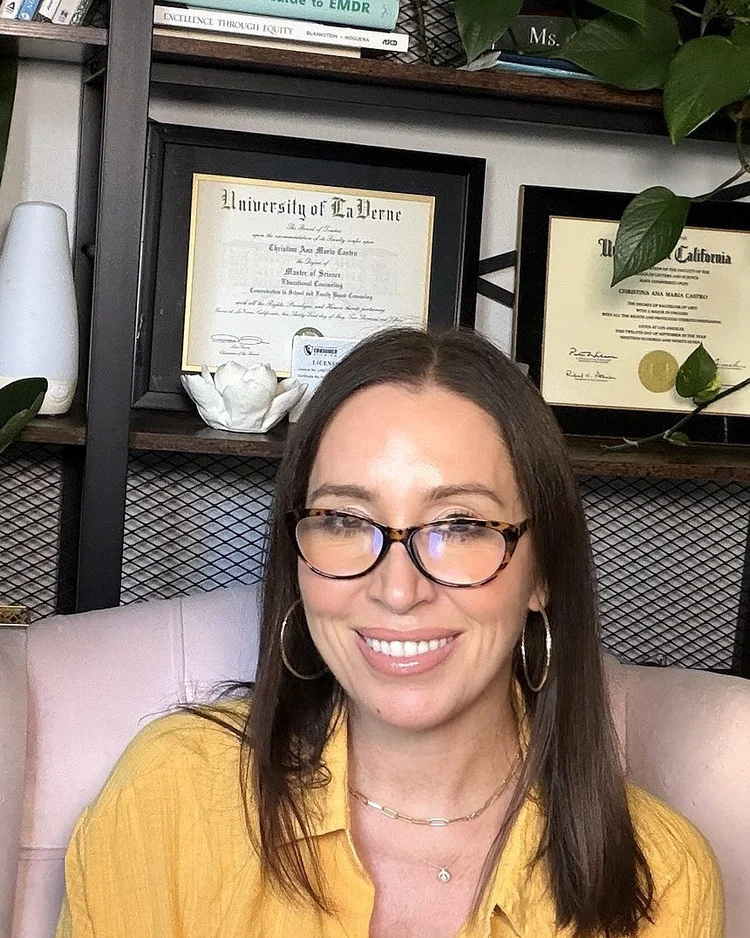
I'm Christina Castro, LPCC (CA #10716 · FL #1589 · SC #2226), a licensed therapist and the founder of Brighter Days Teletherapy. I focus on women whose mental health is tangled up with their hormones and their health, because I've seen how often their struggles get dismissed as “just stress” or “just your age,” and how much changes when someone finally takes them seriously.
I'm trained in EMDR and attachment-focused EMDR, and I teach AF-EMDR to other therapists. I'm currently completing the Women's Health and Wellness Program through Harvard Medical School Executive Education, which covers the science of hormonal, brain and emotional health in midlife, so I can better support you alongside your medical care.
Know what to expect before you start
I'm in-network with Aetna and First Health, and I bill most other PPO plans for you, so there are no superbills to hassle with. Sessions are online, anywhere in California, with a limited number of evening openings for Florida and South Carolina.
Frequently asked questions
Can therapy help with perimenopause anxiety?
Yes. Therapy can't change your hormones, but it can help you manage anxiety, sleep worries, irritability and low mood, and it works well alongside medical treatment. Many women find that having both makes the biggest difference.
Is a sense of doom or dread normal in perimenopause?
Many women describe a sudden sense of dread, often in the morning or at night, during perimenopause. It's common, but it's still worth taking seriously. Talk with your doctor too, to rule out other causes.
What's the difference between PMS and PMDD?
PMS is common and uncomfortable. PMDD is a recognized depressive disorder: the mood symptoms are severe enough to disrupt work and relationships, show up in the week or two before your period, and ease a few days after it starts. Tracking your mood for two cycles is the best way to see the pattern, and I can help you do that.
Can perimenopause make bipolar disorder worse?
It can. Research shows mood episodes are more likely during perimenopause for some women with bipolar disorder, especially those with a history of PMS, PMDD or postpartum depression. Therapy alongside your psychiatrist can help you catch changes early.
Is there a link between trauma and autoimmune disease?
Large studies have found that people with PTSD and women with more difficult childhood experiences have a higher risk of autoimmune disease. Trauma isn't the only factor, and it doesn't mean your illness is “in your head.” It does mean that working through trauma can be part of caring for your whole health.
Do I need to be on hormone therapy first?
No. You can start therapy whether or not you're on hormone therapy, considering it, or not interested. Therapy and medical care work well together, and I'm glad to coordinate with your provider.
How do I know if it's my hormones or something else?
You don't have to know before reaching out. Many women come in unsure. We'll look at what's going on in your life, your history and your symptoms together, and I'll encourage you to check in with a doctor about the medical side.
How long does therapy take?
It depends on what you're working on. We'll check in regularly on how it's going, so you always know where you are.
Do you offer online sessions?
Yes, all sessions are online by secure video, so you can meet from home, your car or your office on a break. On low-energy or flare days, that can make it possible to keep showing up for yourself. I see clients anywhere in California, and I have a limited number of evening openings for clients in Florida and South Carolina.
Do you take insurance?
I'm in-network with Aetna and First Health. For most other PPO plans, I bill your insurance for you as an out-of-network provider, so there are no superbills to hassle with. See the fees and insurance page.
You don't have to figure this out alone.
Whether it's your cycle, perimenopause, a mood condition or your health, you deserve care that sees the whole picture. Let's talk about what you're going through and whether working together feels right.
If you are in crisis or thinking about harming yourself, call or text 988 (Suicide & Crisis Lifeline), or call 911.
Christina Castro, LPCC: CA #10716, FL #1589, SC #2226. This page is for information only and does not create a therapist-client relationship.
Research cited on this page
- Shitomi-Jones et al. (2024). First onsets of mania and major depressive disorder in perimenopause. Nature Mental Health. Summary
- Gordon-Smith et al. (2025). Reproductive events among postmenopausal women with bipolar disorder. Archives of Women's Mental Health. Article
- Song et al. (2018). Stress-related disorders and subsequent autoimmune disease. JAMA. PubMed
- Roberts et al. (2017). Trauma, PTSD and risk of lupus. Arthritis & Rheumatology. Summary
- Köhler-Forsberg et al. (2025). Adverse childhood experiences, mental distress and autoimmune disease in adult women. Psychological Medicine. Summary